AWARE PARENTS BUILD STRONG AND SUPPORTIVE COMMUNITIES
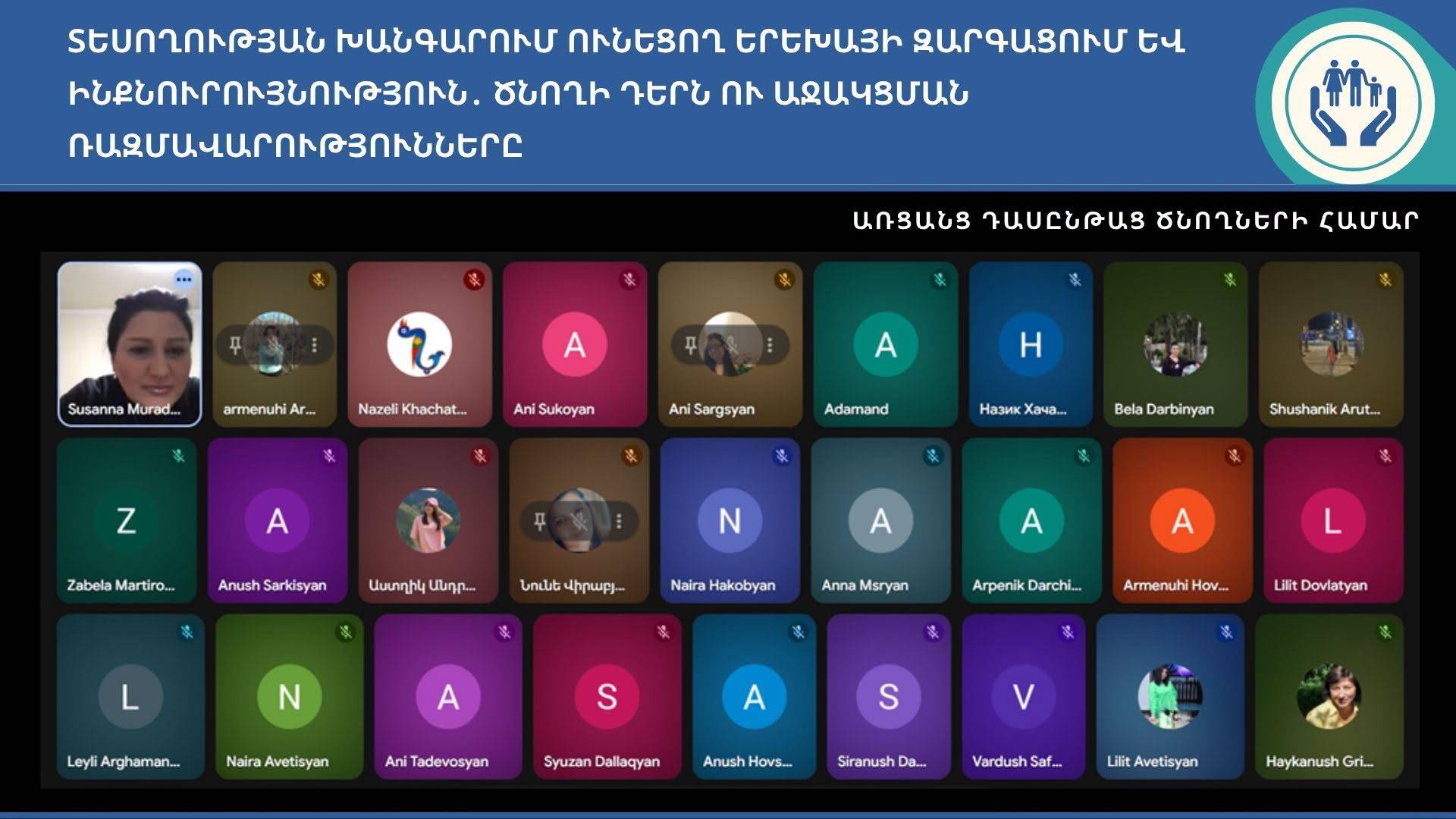
On September 25, 2026, an online course for parents was held on the “DEVELOPMENT AND INDEPENDENCE OF A CHILD WITH A VISUAL IMPAIRMENT: THE PARENT’S ROLE AND SUPPORT STRATEGIES” topic.
The trainer of the Course was Susanna Muradyan, Specialist at RPPC Content Development Department, PhD in Pedagogy, Associate Professor.
The aim of the Course was to provide parents and specialists with knowledge and practical approaches to foster the development of children with visual impairments and encourage their active participation in daily activities.
Effective strategies for fostering children’s independence, self-confidence, orientation skills, and everyday living skills, as well as promoting their initiative and social participation, were presented during the Course.
The roles and responsibilities of parents and specialists in providing children with the necessary support, while refraining from performing tasks on their behalf and allowing them opportunities to explore and develop their own abilities, were also discussed. The importance of working collaboratively with the child was emphasized, with programs and activities being designed and implemented not for the child, but together with the child.
Particular attention was attached to creating a safe, accessible, and developmentally supportive environment, including the use of environmental adaptations, clear and precise spatial vocabulary, and multisensory learning approaches. The Course also addressed strategies for compensating for visual difficulties, tools for individual planning and parental self-assessment, as well as potential risks of bullying and mechanisms for its prevention.
Importance was also placed on the cooperation between the family, the school, and specialists, with the aim of timely identifying the child’s needs and effectively organizing the necessary support for their development.
The training provided participants with an opportunity not only to acquire new knowledge, but also to discuss everyday situations, exchange experiences, and identify effective ways to support children without imposing unnecessary limitations.
28.09.2026